| 
|




 <h3>Friends Newsletter No. 44</h3>
 <h3>July 2012</h3>
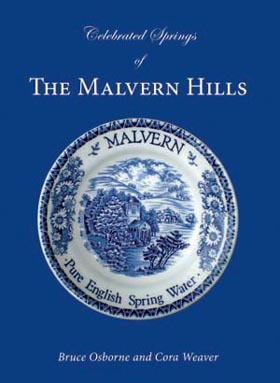 Gateway to the Springs and Wells -
BOOK LAUNCH AND VOUCHER
The book, the largest and probably the most elegant ever to have been written about Malvern, is £25.00, but, as a Friend of Malvern Springs and Wells, you can take advantage of our special offer. You are invited to come to the book's launch at the Gateway to the Springs & Wells - Mount Pleasant Hotel on Belle Vue Terrace - on Saturday 11th August between 10am and 1pm. Sit with a coffee (provided by the management) and look at a rolling on-screen presentation of images from the book, then buy your book at the special discounted price of just £20, using the voucher printed on the last page of this newsletter.
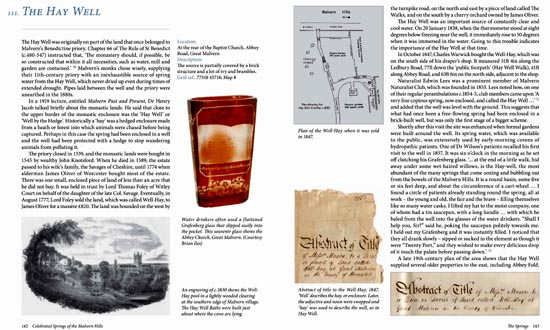
Cora & Bruce
Quick Sand - Friend or Foe?
A potentially dangerous problem when dealing with spring water is quicksand. We have all no doubt seen movies where the hero or heroine is sucked into the seething morass only to be rescued at the last minute or alternatively to disappear for ever. Quicksand is fine grained sand that has liquefied due to water saturation. As a result it is no longer able to take weight and a heavy object will sink. As it sinks the sand consolidates around the object or body and this makes it difficult to drag it or oneself out. Also if clothes are worn, these become heavier with saturation and in turn add to the weight of the body, which in turn brings about an increase in the likelihood of sinking further.
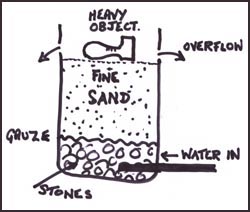 getting out is to float out of the morass. This is easier said than done if you are up to your waist, weary and wet.

 Pleasant Hotel for afternoon tea and cakes, Bruce then presented the case for the new visitor centre Gateway to the Hills, to be created by transforming the Mount Pleasant Hotel and grounds in Great Malvern.
Bruce said that although not formally named a National Park, the Malvern Hills are arguably Great Britain's original National Park. Established as a protected landscape by Act of Parliament in 1884, the Malvern Hills Conservators own and manage the landscape on behalf of the nation, thus conforming to the international definition of a National Park. There are now 15 formal British National Parks, all established since the Second World War and the Malvern Hills makes an unnamed 16th. One big difference however between the Malvern Hills and National Parks is that the Malvern Hills lacks a formal Visitor Centre, often the first stopping off place for tourists.
A further issue with Malvern is the link between the town and the hills. Many visitors can see the hills but do not know how to reach them. This is now being addressed by the 'Route to the Hills' scheme initiated by Malvern Hills District Council. The Mount Pleasant is ideally located as the link between the landscape of the Hills and the townscape and this is addressed through the aptly named Gateway project.
Following the presentation, the Gateway to the Hills project was launched with a champagne toast, when young Joshua Thiele skilfully rang a welcoming peal on an historic brass hand bell looked on by 'AJ' the manager and Bruce. Joshua, from North Staffordshire, was visiting Malvern with his family, and was one of a number of tourists and local people at the launch. Then Cora and Bruce together cut the ribbon at the entrance to the Mount Pleasant's new Malvern Tea Rooms, the first stage in the development of the extended facilities.

"We believe this is a much better proposition than trying to re-establish a tea hut on the summit of the hills or a series of ad hoc services scattered over a wide area," said Bruce, "The Gateway will be the visitor centre for what is really Britain's original National Park".
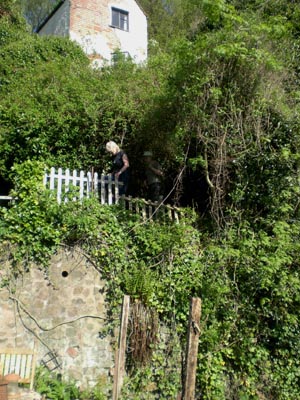
We were recently invited to explore some archaeology at the Royal Malvern Spa at West Malvern. In particular, high on the cliff at the rear of the now demolished spa site, is the remains of a double curved step and evidence of a water supply. Researching contemporary scripts that described the spa in the 19th century, we have been able to identify this as the remains of the original plinth that held the central statue fountain. Investigation of early images, particularly the depiction on a celebration medallion, suggests that the main hall was at first floor level. This enabled us to clarify in our minds why the remains were poised nearly 20 feet above the present ground level. In addition numerous decorative stone ornamentations were found in the vicinity, which also appear to be artefacts from the original building.
The Royal Malvern Spa Hall and Pleasure Gardens were officially opened on 7 May 1883. The following contemporary texts describe what we have discovered:
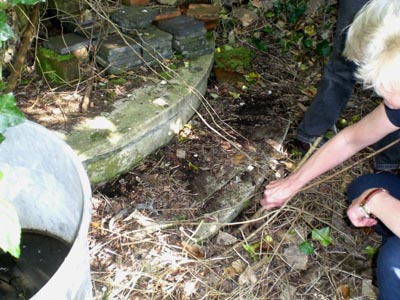
In the pictures: Cora climbs the precarious cliff that was once the back eastern wall of the spa building, to find the peculiar rounded plinth upon which once stood the angel dispensing the healing waters.
Having unearthed a significant piece of Malvern's past we have to consider what is best done to preserve these artefacts. This is a question that remains unanswered at the moment.
Email: springs@thespas.co.uk (click here to send an email)
Website: Click Here
SUPPLEMENTARY INFORMATION
 Newsletter Archive which can also be accessed from our WEB SITE INDEX.
Friendship - There is no charge made for joining Friends of Malvern Springs and Wells. Just let us have your email address and we will send our newsletters, which are usually two monthly. Please be aware that some email addresses block large circulation emails. Do feel free to participate in our activities by contacting us below.

Best wishes, Cora & Bruce
Tel. 01737 213169 email bruce@thespas.co.uk
Tel. 01684 561215 email cora@malvernspa.com
1) TOPOGRAPHICAL LOCATION:
Malvern Hills - arguably Britain's original National Park
3) INFORMATION CATEGORY:
Springs and Wells General InterestHistory & Heritage
Friends Newsletter